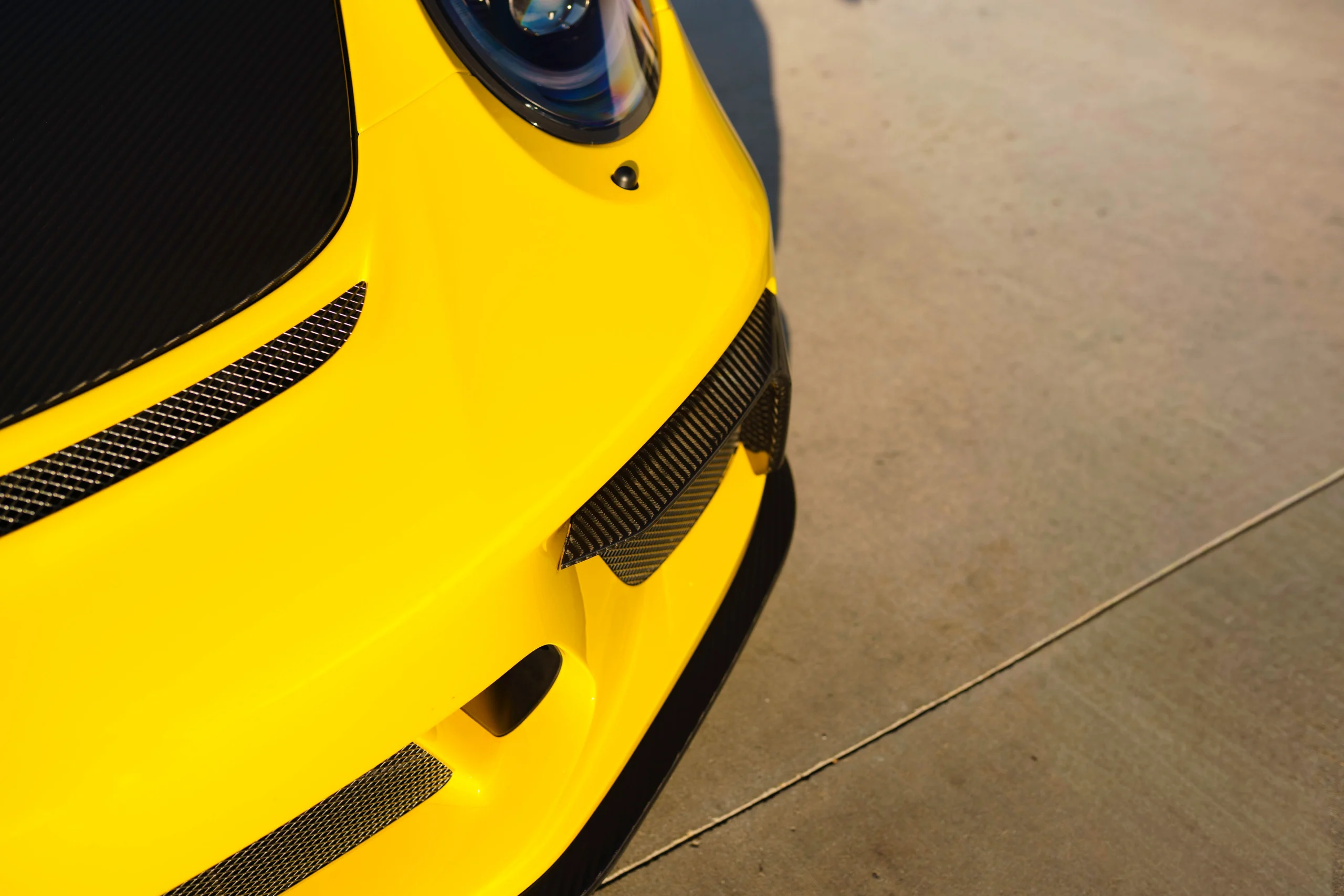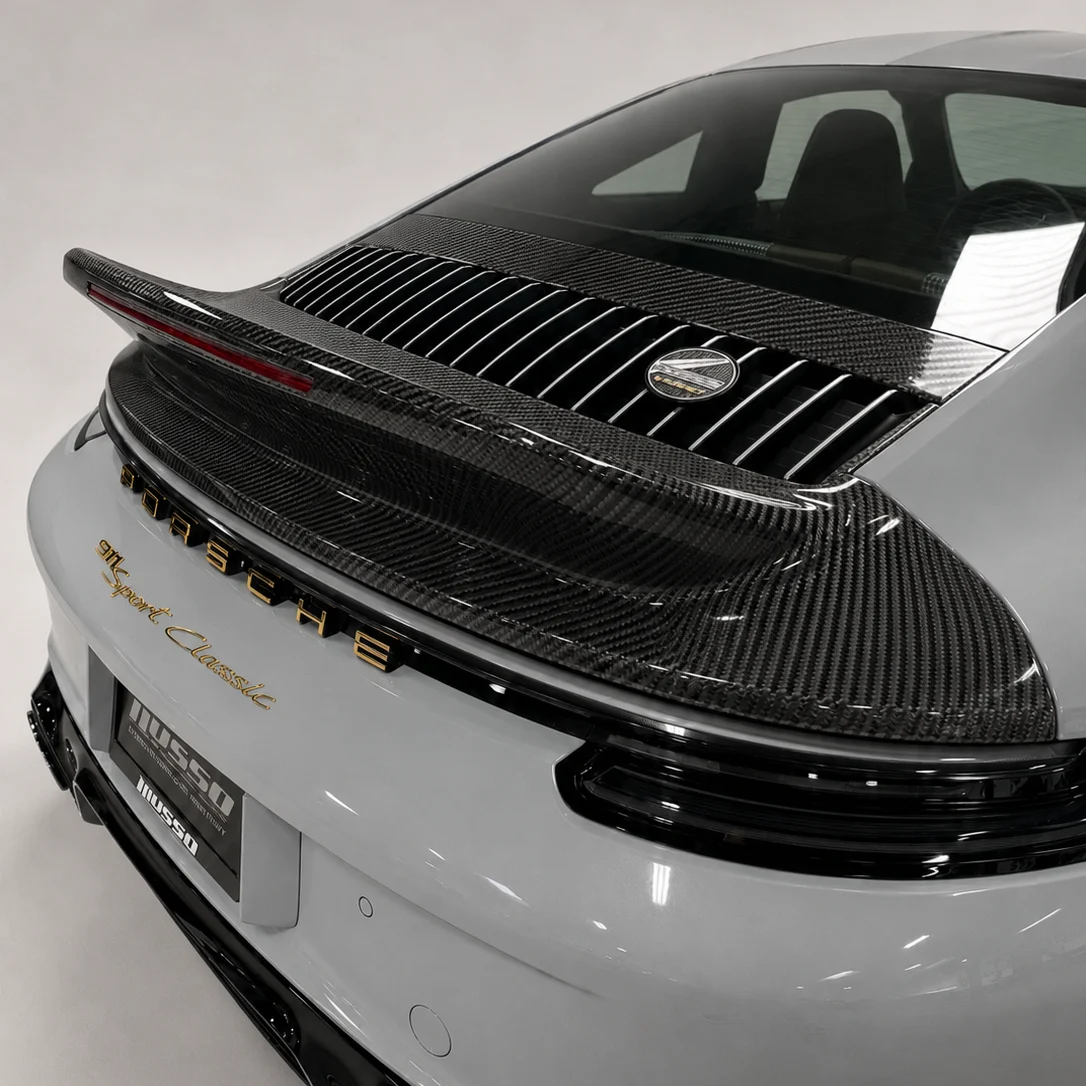
For over six decades, the Porsche 911 has defined its legacy through structural and mechanical defiance.
By placing the engine behind the rear axle, Porsche’s engineers created a car with legendary traction out of corners, unmatched braking stability, and a distinct driving character that punishes the uninitiated and rewards the precise.
Yet, this rear-engine configuration introduces a permanent engineering paradox: how do you maintain absolute front-end mechanical grip and razor-sharp steering turn-in when the laws of physics are constantly trying to pull weight away from the front tires?
While adding power is the standard path to straight-line speed, true Porsche purists understand that weight reduction is the ultimate weapon for cornering performance. Every pound stripped from a vehicle alters its dynamic behavior, but where you remove that weight alters its soul.
Replacing the factory aluminum front hood with a lightweight, aerospace-grade, autoclave-cured pre-preg dry carbon fiber unit is not a mere styling choice.
It is a highly calculated calibration choice. By reducing mass at the absolute leading edge of the vehicle, you directly optimize the 911’s polar moment of inertia, lower its center of gravity, and transform the front-end steering response from excellent to telepathic.
The Physics of the Rear-Engine Layout: The Nose-Heavy Paradox
To understand why front-end weight reduction is so profoundly effective on a modern Porsche 992 or 991 platform, one must first look at the static and dynamic weight distribution of the vehicle.
Under static conditions, a modern 911 typically maintains a weight distribution of roughly 38% front and 62% rear. When the vehicle is at rest or accelerating hard out of an apex, the rearward weight bias jams the wide rear tires into the asphalt, providing the immense traction for which the platform is famous.
However, as the vehicle enters a corner, the dynamic loading changes dramatically. The moment the driver lifts off the throttle or applies the brakes, kinetic energy transfers forward, loading the front suspension and pressing the front contact patches into the road. If the front end carries too much sluggish, high-positioned mass, two negative handling phenomena occur:
- The Pendulum Effect: Mass located far from the car’s center of rotation resists directional changes. When you turn the steering wheel, that forward mass wants to continue traveling in a straight line, fighting the front tires and causing understeer.
- Delayed Transient Response: During rapid left-to-right transitions—such as a fast chicane or an emergency lane change—high-positioned front mass creates a pendulum lag. The chassis rolls, the front suspension compresses heavily on one side, and the driver must wait for the weight to settle before the car can fully hook up and track straight.
By swapping a heavy factory metal panel for a ultra-lightweight carbon fiber structure, you are not simply making the car lighter overall; you are fundamentally reducing the amount of work the front tires must perform to alter the vehicle’s direction.

Polar Moment of Inertia and the Mechanics of Rotation
In automotive engineering, the ease with which a car rotates around its vertical axis (yaw) is dictated by its Polar Moment of Inertia.
Think of a figure skater spinning: when they extend their arms out wide, their rotation slows down dramatically because mass is distributed far from the axis of rotation. When they pull their arms tightly against their chest, their spin accelerates instantly.
A car operates under the exact same physical law. If a vehicle has heavy components placed at its absolute extremities – the front nose and the rear bumper – it will inherently resist changing direction. Conversely, if you centralize the vehicle’s mass within the wheelbase, the car will pivot with astonishing agility.
Because the distance is squared in this fundamental physics equation, any mass located far away from the center of gravity has a massively disproportionate effect on handling.
The front hood sits at the furthest practical point forward of the passenger cabin. Therefore, removing even a seemingly small amount of weight from the hood yields a dramatic reduction in the polar moment of inertia.
The practical result on the track or carving a winding canyon road is immediate. The moment you initiate steering input, the front axle responds without hesitation.
The car feels lighter on its feet, steering effort decreases, and the front tires maintain a more stable, predictable contact patch because they are no longer fighting the inertia of a heavy metal panel swaying across the nose.
The Material Science: Aluminum vs. Autoclave Pre-Preg Dry Carbon
When discussing aftermarket carbon fiber panels, the word “carbon” is frequently thrown around as a catch-all marketing term.
However, the manufacturing methodology determines whether a component provides a true performance upgrade or a heavy, hazardous downgrade.
The Pitfalls of Wet-Laid and Carbon-Overlay Aesthetics
Many mass-market aftermarket manufacturers produce what is known as “wet carbon” or fiberglass-backed panels.
These parts are constructed by laying dry carbon sheets into a mold and manually brushing or spraying liquid resin over them. To cut costs, many companies use a thin top layer of carbon fiber backed by multiple thick layers of heavy fiberglass chopped-strand mat.
Because these panels are cured at room temperature without compression, they require an immense amount of resin to achieve structural rigidity.
Resin adds weight without adding strength. Consequently, a cheap wet-laid carbon hood frequently weighs more than the factory Porsche aluminum hood. Furthermore, under extreme engine bay heat or intense sunlight, the excessive resin will yellow, outgas, crack, and warp, destroying both the visual appeal and the panel gaps of the vehicle.
The Aerospace Standard: Pure Autoclave Pre-Preg (Dry Carbon)
At OG Carbon, every body panel is engineered using 100% pre-impregnated (pre-preg) carbon fiber matrix materials, cured inside a high-pressure industrial autoclave.
Pre-preg material means the carbon fibers are mechanically infused with the exact, mathematically perfect ratio of epoxy resin by the manufacturer at the factory level.
There is no excess resin, no human error, and no wasted weight.
Once the carbon sheets are precisely laid into CNC-machined billet aluminum tooling, the mold is vacuum-sealed and placed inside the autoclave. Under immense heat and pressures exceeding several atmospheres, the carbon layers are compressed and fused into a unified, ultra-dense composite structure.
| Material Type | Structural Rigidity | Weight Profile | Thermal Stability |
| Factory OEM Aluminum | Moderate (Industry Standard) | Baseline (~18-22 lbs) | High |
| Cheap Wet-Laid/Fiberglass | Low (Flexes at High Speed) | Heavy (~24-30 lbs) | Poor (Prone to Warping) |
| OGC Autoclave Pre-Preg | Extremely High (Aerospace) | Ultra-Light (~7-9 lbs) | Absolute (Stable past 300°F) |
By utilizing autoclave technology, we are able to slash the weight of the front hood by up to 60% compared to factory aluminum, while simultaneously increasing structural rigidity.
This added stiffness is critical; it ensures that at speeds crossing the 180 mph threshold on the track, the hood experiences zero aerodynamic deflection or fluttering, maintaining clean, laminar airflow over the top of the vehicle.
The experts at OG Carbon have an entire blog on dry carbon v. wet carbon fiber, check it out here!
Center of Gravity and Roll Center Optimization
Beyond the horizontal plane of rotation, we must look at the vertical distribution of mass.
Every pound of weight removed from the upper half of a vehicle lowers its Center of Gravity (CoG). The center of gravity is the theoretical point where the entire weight of the car is concentrated.
When a car corners, centrifugal force acts upon the center of gravity, causing the body to roll outward. The distance between the vehicle’s center of gravity and its geometric Roll Center (dictated by suspension geometry) acts as a leverage arm.
The longer this leverage arm, the more the car wants to lean and roll during cornering.
| High Center of Gravity | Long Leverage Arm | Severe Body Roll / Slower Weight Transfer |
| OGC Low Center of Gravity | Short Leverage Arm | Minimal Body Roll / Immediate Lateral Grip |
By removing mass from the highest point of the front bodywork – the hood, you directly shorten that leverage arm.
Lowering the center of gravity reduces body roll without requiring you to install overly stiff anti-roll bars or unforgiving spring rates that ruin ride compliance and disrupt tire mechanical grip on bumpy surfaces.
A lower center of gravity ensures that the car transitions weight evenly across all four tires, keeping the inner tires planted and maximizing total lateral grip.
Engineering the Hidden Imperative: Crash Safety and Latches
When upgrading structural body panels on a high-value supercar, structural integrity and safety must never be compromised for the sake of weight savings.
The front hood of a modern Porsche is a highly engineered safety device designed to protect occupants in a severe frontal collision.
Energy Dissipation and Progressive Crumple Zones
Factory aluminum hoods are engineered with specific indentation patterns on their underside skeleton.
In a front-end crash, these patterns act as mechanical fuses, forcing the hood to buckle cleanly and fold into a “V” shape.
This progressive deformation absorbs massive amounts of kinetic energy and prevents the hood from breaking free of its hinges and slicing backward through the windshield into the cabin.
Cheap aftermarket carbon fiber hoods lack this internal engineering. They are often built as a flat, single-wall sheet or a hollow double-wall shell with no internal bracing.
In an impact, these poorly designed panels can shatter violently or behave like a solid plate, transferring dangerous collision energy directly into the chassis and passenger cell.
The OG Carbon Inner Rigidity Framework
To solve this engineering challenge, OG Carbon replicates the complex geometric structural reinforcement matrix on the underside of the lid.
Utilizing advanced computer-aided engineering (CAE) simulations, we design internal composite support ribs that mirror the progressive energy dissipation pathways of the factory hood. In the event of an impact, the hood is engineered to deform predictably, maintaining the vehicle’s structural safety integrity.
| OGC INNER STRUCTURAL ARCHITECTURE | |
| COMPONENT | REINFORCEMENT METHODOLOGY |
| Perimeter Frame | Continuous Hollow Carbon Box Section |
| Latch Mounting Zone | Integrated CNC Billet Steel Inserts |
| Hinge Receivers | Blind Threaded Titanium Load Blocks |
Furthermore, secondary hood latches are a primary failure point on lower-tier aftermarket body panels.
At high track speeds, the low pressure created over the top of the hood creates an intense lifting force. If the latch mounting point is simply bonded to the carbon with standard adhesive, it can tear free, causing the hood to fly open instantly at speed.
OG Carbon addresses this by embedding CNC-machined metal plates directly inside the pre-preg carbon layers during the layup process before curing.
The factory latches and hinges bolt directly into these reinforced, blind-threaded metal inserts, ensuring that the hood stays locked flat against the chassis at V-max without requiring unsightly, track-only exterior hood pins.
Aerodynamic Stability and Thermal Management Options
For extreme track builds, a carbon fiber hood provides the perfect platform to integrate functional aerodynamics and thermal management systems that would be impossible or prohibitively expensive to execute on a factory aluminum panel.
Replicating Motorsport Aerodynamics
On platforms like the 992 GT3 RS and 991.2 GT2 RS, Porsche utilizes aggressive nostrils and ducting carved into the front lid.
These cutouts serve a vital aerodynamic purpose: they allow hot, high-pressure air that has passed through the front central radiators to escape upward out of the front trunk bay, rather than pooling underneath the car.
When high-pressure air builds up under the front floor pans, it creates front-end lift, causing the steering to feel dangerously light and unstable at high track speeds.
Rerouting this air out through the top of a custom-vented OG Carbon hood creates an area of low pressure beneath the car, pulling the front nose down toward the asphalt and generating clean, usable downforce without adding drag.
Thermal Protection for the Finish
Because the front trunk cavity of a Porsche can act as a heat sink – especially on turbocharged models like the 992 Turbo S or GTS where front auxiliary coolers run at high operating temperatures, OG Carbon coats the entire underside of every hood with a thermal-stabilized clear resin system.
This prevents the composite matrix from degrading over thousands of thermal cycles, ensuring that your investment maintains its structural integrity and flawless aesthetic appeal for decades to come.
Read the OG Carbon guide to Porsche 992.2 aerodynamics!

The OEM+ Standard: Fitment, Gaps, and Finish Integration
The most common frustration among exotic car collectors purchasing aftermarket body components is poor fitment.
A supercar can have thousands of dollars in performance upgrades, but if the panel gaps along the fenders are uneven, crooked, or tight enough to rub the paint off, the value and prestige of the vehicle are instantly compromised.
Explore OEM+ in OG Carbon’s guide to achieving the ultimate OEM+ evolution!
Precision 3D Scanning and Digital Tooling
To eliminate fitment variability, the engineering process at OG Carbon begins with a high-definition, blue-light 3D laser surface scan of a factory-fresh OEM vehicle chassis.
This allows us to map the exact three-dimensional topography of the factory latch locations, hinge angles, fender radii, and weatherstripping tracks down to a tolerance of less than 0.05mm.
From this digital master data, our tooling engineers cut production molds out of solid blocks of aerospace-grade billet aluminum using a 5-axis CNC mill.
Because aluminum molds have a matched coefficient of thermal expansion to the carbon fiber during the heated autoclave process, the final cured parts emerge from the mold with absolute geometric accuracy.
The panel gaps on an OG Carbon hood align perfectly with your Porsche’s factory lines, ensuring a true “OEM+” integration that looks like it rolled directly out of the Weissach development center.
Visual Masterpieces: The 6K V-Weave Finish
For owners who want to proudly display the engineering artistry of their panel, OG Carbon offers our signature 6K V-Weave centerline layout.
Rather than running a single piece of carbon fabric across the entire width of the panel – which causes the weave pattern to distort and bend along the aggressive contours of the hood, our master technicians execute a book-matched layout.
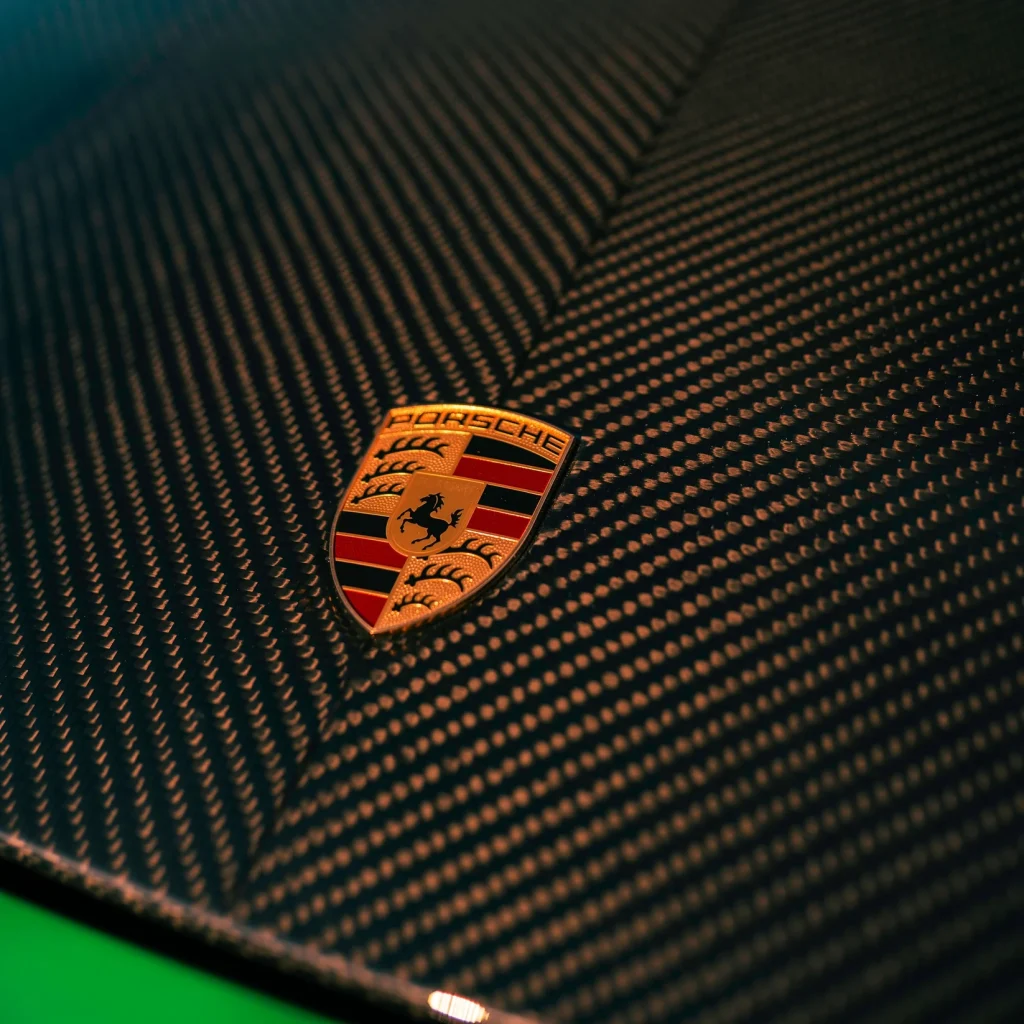
Two mirror-image carbon sheets are meticulously aligned down the absolute center axis of the hood, creating a sharp, perfectly symmetrical “V” pattern that flows seamlessly from the base of the windshield straight down to the front Porsche crest.
To protect this intricate carbon weave from the elements, the panel is finished with multiple coats of premium, marine-grade PPG ultra-high-solid UV clear coat.
The clear coat is systematically baked, block-sanded by hand, and polished to a deep, glass-like mirror sheen that resists rock chips, prevents UV oxidation, and perfectly matches the factory paint finish of your vehicle.
Speaking of weave – check out our blog on 2X2 Twill vs. V-Weave Carbon Fiber: The Porsche Owner’s Guide to Flawless OEM+ Styling.
Summary: The Calculated Return on Mass Reduction
Upgrading to an OG Carbon Autoclave Pre-Preg Carbon Fiber Front Hood represents the pinnacle of calculated automotive refinement.
By replacing heavy factory aluminum with structurally superior, ultra-lightweight dry carbon, you execute a holistic performance transformation across every metric of driving dynamics:
- Telepathic Handling: Dropping mass from the extreme front nose lowers the vehicle’s polar moment of inertia, allowing for near-instantaneous steering transitions and eliminating front-end pendulum resistance.
- Enhanced Grip: Optimizing the vehicle’s center of gravity stabilizes the front tire contact patches, significantly reducing understeer during hard apex entries.
- Motorsport Safety: The integrated internal reinforcement matrix preserves engineered crash crumple pathways, maintaining structural safety at triple-digit track speeds.
- Impeccable Presentation: Digital 3D scans and precision aluminum tooling guarantee flawless, factory-level panel gaps and a stunning, book-matched 6K V-Weave visual statement.
Performance isn’t just about what you add to your Porsche; it’s about what you intelligently remove. Strip away the dead weight and experience your chassis exactly as the engineers intended: uncompromised, balanced, and blindingly fast.
Ready to Optimize Your Build?
If you are ready to elevate the performance and visual presence of your Porsche 992, 991, or custom restomod project, contact the experts at OG Carbon.
Head over to the OG Carbon catalogue to learn more about our weave customizations, and bespoke carbon fiber configuration options.
Lastly, the OG Carbon Fever blog is full of fascinating resources to nerd out on, with content curated for discerning Porsche owners.