For generations of Porsche purists, the silhouette of a sweeping rear ducktail evokes an immediate, visceral response. It calls back to the legendary 1973 911 Carrera RS 2.7 – a car where styling wasn’t born in an executive design studio, but hammered out through grueling track sessions and computational fluid dynamics.
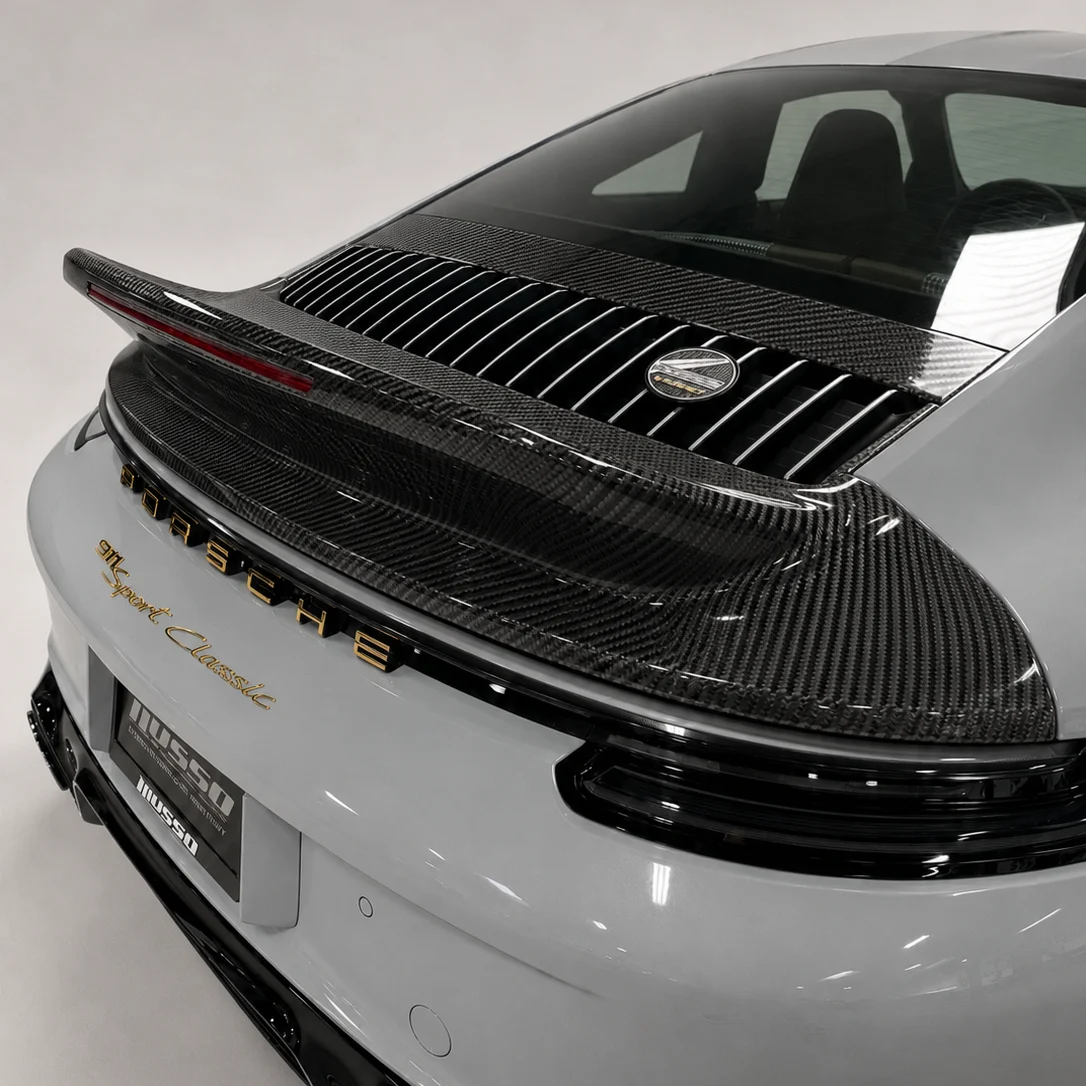
When applied to the modern Porsche 992 platform (including Carrera, GTS, GT3 Touring, and Turbo models), a fixed ducktail spoiler represents the absolute pinnacle of an “OEM+” aesthetic. It strips away the complex, multi-piece motorized visual break of the factory pop-up wing, replacing it with clean, uninterrupted classic lines.
But modern water-cooled 911s are incredibly precision instruments of fluid dynamics. Changing the rear profile of a machine designed to breach 190 mph is never just a cosmetic choice. If you are considering upgrading your 992 with a premium carbon fiber ducktail, you need a complete understanding of how altering the factory active aerodynamics affects downforce, intercooler cooling, high-speed stability, and vehicle telemetry.
Check out OG Carbon’s Ultimate Guide to Porsche Aerodynamics.
| Factory Setup: | Variable Motorized Wing | Fluctuating Downforce & Airflow |
| vs. | ||
| Ducktail Setup: | Variable Motorized Wing | Constant, High-Speed Stabilized Downforce |
The Engineering Challenge: Overriding Porsche Active Aerodynamics (PAA)
Every standard Porsche 992 leaves the Zuffenhausen factory relying on a highly complex network known as Porsche Active Aerodynamics (PAA). From the factory, your rear spoiler is a variable-stage motorized wing. It doesn’t just go up or down; it changes its angle of attack dynamically based on real-time driving conditions:
- Eco/Normal Mode: The wing remains flush at low speeds to drastically reduce drag coefficient and improve fuel efficiency.
- Performance Mode: It tilts up at approximately 56 mph (90 km/h) to stabilize the rear axle and counter high-speed lift.
- Sunroof Variable: If your sunroof is open, the car’s computer alters the deployment angle to compensate for the disrupted airflow over the roofline.
- Wet Mode: When the acoustic sensors in the front wheel wells detect water on the road, the wing deploys prematurely at its maximum angle to shift the vehicle’s aerodynamic center of pressure rearward, ensuring the car remains planted.
- Airbrake Mode: Under hard deceleration at high speeds, the wing flips up into a high-drag configuration to act as a physical airbrake.
When you install a fixed 992 Ducktail Spoiler, the factory motorized lifting mechanism is entirely uninstalled from the rear decklid structure.
The Electronic Fix: Deactivating the Lift Function
Because the car’s central body control computer expects to actuate a motor and read microswitch positioning data at high speeds, removing the factory mechanism will trigger an immediate dashboard fault code, flashing red warnings and potentially throwing the vehicle into an electronic limp mode limit.
To bypass this, premium aftermarket integrations require deactivating the lift function. This is handled via one of two professional methods:
- PIWIS Factory Coding: Software-recoding the rear body control module (BCM) using a factory Porsche diagnostic tool to recognize a “Fixed Spoiler” profile. This effectively tells the car’s computers that it is now configured like a 992 Sport Classic or a factory Aerokit car, permanently shutting down the motorized commands.
- Hardware Aero Emulator: A seamless plug-and-play emulator module that connects directly into the factory wing wiring harness. This hardware device intercepts the computer’s lift command and echoes back a dummy position signal, tricking the ECU into believing the factory wing is operating perfectly.
Aerodynamic Balance: Preserving the Front-to-Rear Downforce Ratio
A common myth in the aftermarket car community is that adding a rear spoiler always improves handling. In reality, aerodynamics are a zero-sum game of balance. Porsche engineers spend thousands of hours balancing the front splitter lip with the rear wing surface area.
If a rear modification adds significant downforce to the rear axle without a corresponding increase at the front of the vehicle, it creates a dangerous visual see-saw effect at high speeds.
The rear gets pressed hard into the tarmac, compressing the rear springs. Consequently, the front suspension unloads, lifting the front tires slightly. At 100+ mph, this makes the steering wheel feel uncomfortably light, vague, and nervous.
Read more about Porsche aerodynamics in the OG Carbon Fever blog.
The Airbrake Fallacy
Poorly designed, generic fiberglass ducktails copied from older 911 generations often utilize hyper-aggressive, near-vertical angles that generate a near 100% “airbrake” wall of drag. This creates massive rear downforce but severely disrupts the car’s high-speed stability criteria, making emergency lane changes or track turn-ins dangerously unpredictable.
A mathematically engineered carbon fiber ducktail solves this through precise surface modeling. The angle of attack on a premium 992 ducktail is carefully sculpted to closely match the aerodynamic footprint of the factory wing at full extension. It generates clean, consistent downforce without overwhelming the front axle, keeping your 992 perfectly balanced whether you are cruising the highway or clipping apexes at a local track day.
The Thermal Variable: Forced Induction and Ram-Air Cooling
Downforce is only half of the aerodynamic equation on a modern 911. The other half is thermodynamics.
Unlike naturally aspirated air-cooled models of the past, the turbocharged powerplants in the 992 Carrera, GTS, and Turbo platforms place their intercoolers directly under the rear decklid grill. The factory motorized spoiler doesn’t just lift to generate downforce; it lifts to act as a massive scoop, ramming cold, high-velocity air straight down into the intercooler cores.
If you block or restrict that airflow with a poorly designed static panel, your charge-air temperatures will skyrocket. When the ECU detects hot air entering the intake manifolds, it aggressively pulls ignition timing to prevent engine knock, instantly robbing you of horsepower and torque.
To counter this, a high-performance 992 ducktail must feature integrated Ram Air Ducts.
Advanced carbon fiber manufacturing allows for deep, structural air channels sculpted directly into the spoiler’s base. These dual central inlets are engineered to capture the high-pressure air flowing over the roofline and compress it down into the engine bay.
By optimizing internal venturi channels, premium dry carbon ducktails supply an even greater volume of ambient air to the intercoolers than the factory active spoiler does in its standard extended position. Your engine runs cooler, preserves its peak horsepower curves, and thrives under sustained performance driving.
Material Matters: Aerospace Dry Carbon vs. Hand-Laid Wet Carbon
Because a fixed ducktail is exposed to immense aerodynamic pressure at track speeds, the structural integrity of the material is paramount.
A wing flexing or distorting under load will cause severe aerodynamic instability. When selecting a 992 ducktail, the manufacturing process dictates the performance:
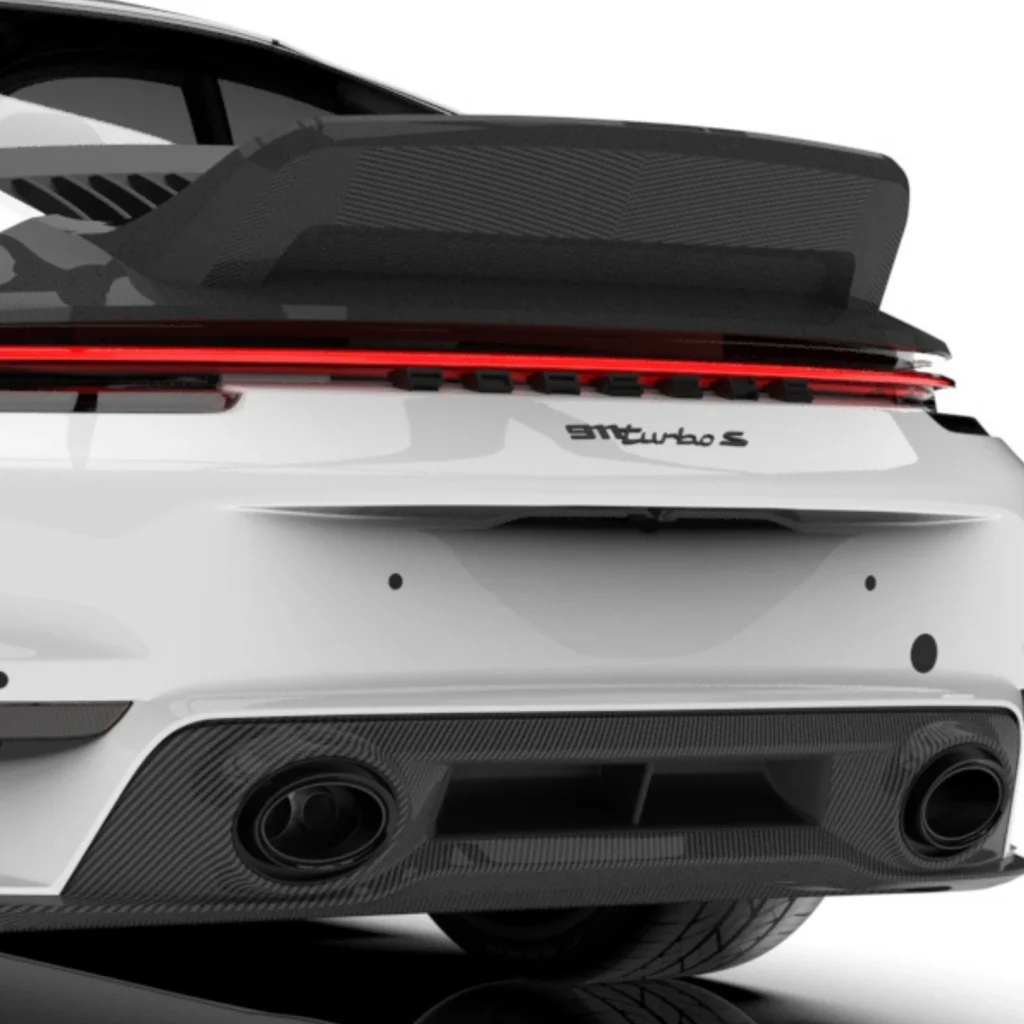
- Wet Carbon Lay-Up: Traditional aftermarket carbon fiber is laid by hand into an open mold, coated in liquid resin, and left to air-dry. This process leaves excess resin trapped within the fibers, resulting in a heavier component that is highly susceptible to structural flexing under heavy downforce load. Over time, engine heat and UV exposure break down the heavy resin layer, causing the clear coat to yellow and cloud.
- Pre-Preg Dry Carbon Fiber: Aerospace-grade manufacturing utilizes carbon sheets pre-impregnated with a precise ratio of resin. The component is sealed in a vacuum bag and cured inside a high-pressure autoclave vessel under intense heat and nitrogen pressure. This eliminates all excess resin, yielding a part that is up to 70% lighter and vastly stiffer than wet carbon alternatives.
For a platform as sophisticated as the 992, dry carbon is the only choice. It ensures the ducktail remains completely rigid under maximum downforce loads, keeping your aerodynamic telemetry stable while saving critical weight at the highest point of the rear axle.
Check out our Automotive Connoisseur’s Guide to Luxury Aero Upgrades: Dry Carbon vs. Wet Carbon Fiber.
The OGC Difference: Pure Visual and Structural Precision
When we engineered our OG Carbon Porsche 992 Custom Parts Program, we set out to build a ducktail that completely honors factory build standards. We don’t believe in universal fitments or parts that require sanding, trimming, or drilling to fit a pristine 911 bumper.
| THE OG CARBON ADVANCED PRODUCT MATRIX | ||
| FACTORY MODEL | OGC DRY UPGRADE | MATERIAL FINISH OPTION |
| Porsche 992 Turbo/S | Bespoke Ducktail Spoiler | 6K V-Weave / 2×2 Twill Seamless Symmetry |
| Porsche 992 Series | Full Carbon Front Luggage Lid/Hood | Autoclave Pre-Preg, ore Density Engineered |
Precision Engineering via 3D Scanning and PPAP
Our manufacturing begins with full 3D laser surface scanning of original factory body tubs. This ensures that every single mounting clip, rubber seal channel, and bolt hole on our ducktail decklid sits in the exact sub-millimeter position as the factory part. We back this with a strict Production Part Approval Process (PPAP), guaranteeing absolute factory-level panel gaps right out of the box.
Visual Artistry: The 6K V-Weave Finish
Because our autoclave process stabilizes the carbon sheets under vacuum before curing, we can manipulate the visual flow of the carbon strands in ways manual manufacturing can’t match.
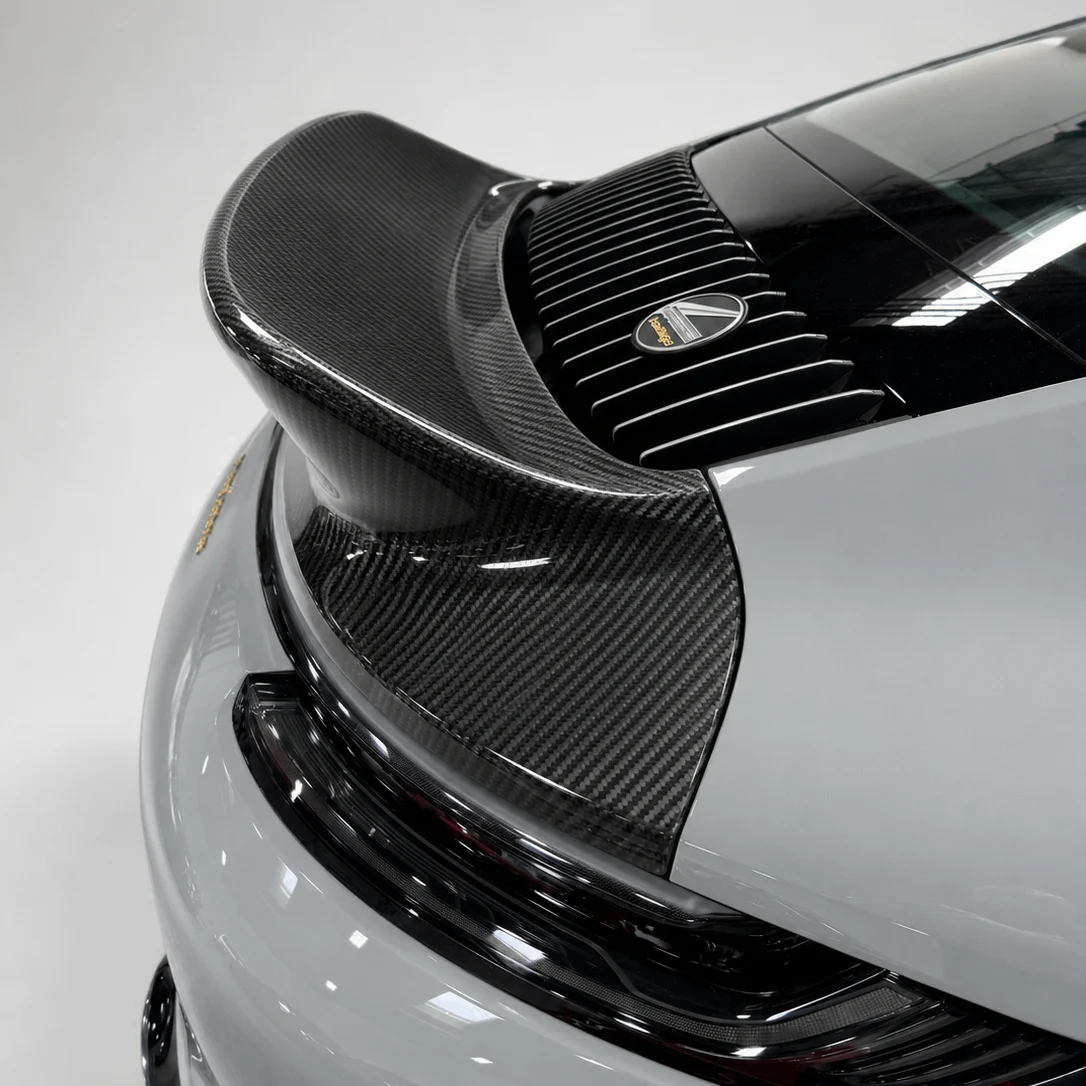
Our signature 6K V-Weave option features a perfect, book-matched chevron split running straight down the exact centerline of the ducktail. The pattern splits beautifully from the center point, creating an incredible mirror-image symmetry that highlights the complex curves of the rear decklid. Finished in premium, high-solid marine-grade PPG clear coats, it delivers an exposed-weave depth that is fully shielded against UV yellowing and engine heat.
Frequently Asked Questions: Navigating the 992 Ducktail Transition
Will installing a fixed ducktail spoiler cause dashboard error codes at high speeds?
Yes, if installed without electronic modifications. Because your Porsche 992 expects to actuate a motorized rear wing at roughly 56 mph, removing that factory mechanism will immediately trigger a spoiler system failure light.
To completely prevent this, your car must either be programmed via a PIWIS diagnostic tool to a “Fixed Spoiler” profile, or fitted with a plug-and-play electronic aero emulator. This tricks the central ECU into believing the factory motorized wing is functioning perfectly, keeping your dashboard completely error-free.
How does a fixed ducktail impact engine cooling compared to the factory active wing?
The factory pop-up wing acts as a physical air scoop to force ambient air directly downward into the mid-mounted intercoolers. To match or exceed this thermal efficiency, a high-quality aftermarket ducktail must feature integrated, vacuum-formed ram-air vents sculpted directly into its base.
These channels use fluid dynamics to compress and funnel high-velocity air flowing over the roofline straight into the engine bay, keeping charge-air temperatures low and preventing the ECU from pulling ignition timing or robbing horsepower.
Can I install a 992 ducktail spoiler myself, or does it require body modifications?
While a premium dry carbon ducktail utilizing 3D-scanned factory mounting brackets will bolt directly to your chassis without cutting or drilling, professional installation is highly recommended.
The conversion requires careful transfer of your factory third brake light wiring, precision alignment of your rear decklid gaps, and the installation of an electronic coding or emulator package to address the active aero telemetry. Using an experienced Porsche technician ensures flawless fitment and structural safety at track speeds.
Elevate Your 992 with OG Carbon
Upgrading to a 992 ducktail spoiler isn’t a compromise between style and performance – provided the engineering is correct.
By opting for a mathematically sculpted, dry carbon fixed system with integrated high-volume ram-air ducts, you achieve the classic, uninterrupted lines of Porsche’s heritage models while actually optimizing high-speed stability and cooling efficiency.
At OG Carbon, we specialize in bringing true autoclave pre-preg dry carbon performance to elite builds. Whether you want to enhance your 992 Turbo, Carrera, or GTS with a heritage-inspired profile, our technical design collective is ready to deliver.
Connect with Our Technical Team
Ready to upgrade your vehicle’s performance and luxury profile with true, autoclave-cured dry composites?
Contact the OG Carbon experts today to discuss your project specifications or custom retail parts inquiry, and check out our Porsche 911 (992) carbon fiber parts collection.